
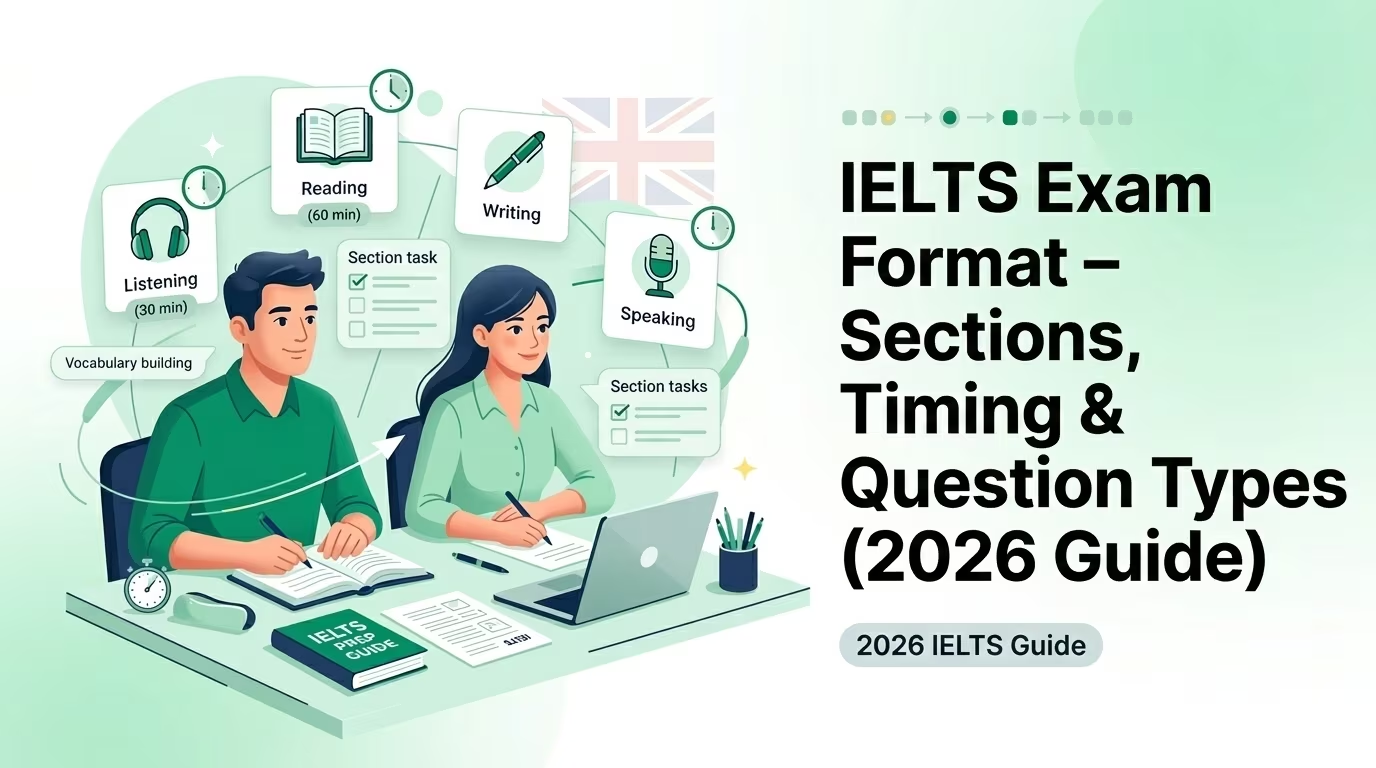
A Complete Guide to IELTS Exam Format, Sections, Timing, Question Types (2026)
Whether you're aiming for Band 7 for a UK student visa or Band 8 for Canadian PR, your first step is decoding the exact IELTS exam format — the four sections, the timing for each, and the full set of question types you'll meet on test day. Even fluent English speakers lose marks to time pressure and unfamiliar question formats.
The International English Language Testing System (IELTS) is not just a test of your English vocabulary and grammar; it is a test of strategy, endurance, and time management. Every year, thousands of test-takers lose valuable marks simply because they were surprised by a specific map-labelling task in the Listening section or mismanaged their 60 minutes in the Reading module.
In this guide we break down the exact 2026 structure of the IELTS exam — every section, every timing rule, every question type — so you can walk into test day knowing precisely what to expect and how long you have for each task. Let's build your foundation for a Band 8+ score.
📊Overview: IELTS Exam Format Sections Timing Question Types
Before we dissect each module individually, you must grasp the macro-structure of the test. The IELTS exam evaluates your proficiency across four key language skills: Listening, Reading, Writing, and Speaking.
The total test duration is exactly 2 hours and 45 minutes. While the Listening, Reading, and Writing sections are completed on the same day with no breaks in between, your Speaking test may be scheduled on the same day or up to seven days before or after your main test date.
| Test Section | Time Allocated | Number of Questions | Key Objective |
|---|---|---|---|
| Listening | 30 minutes (+10 mins transfer time for paper-based) | 40 Questions | Understand everyday conversations and academic lectures. |
| Reading | 60 minutes | 40 Questions | Grasp main ideas, details, and author's opinions. |
| Writing | 60 minutes | 2 Tasks | Formulate a clear argument and describe data logically. |
| Speaking | 11 to 14 minutes | 3 Parts | Communicate opinions and discuss abstract topics fluently. |
🎧IELTS Listening: Format & Question Types
The Listening section is identical for both Academic and General Training candidates. You will listen to four distinct recordings of native English speakers—featuring a range of accents including British, Australian, New Zealand, and North American—and write your answers to a series of questions.
The 4 Parts of IELTS Listening
- Part 1A conversation between two people set in an everyday social context (e.g., booking a hotel room or registering for a gym).
- Part 2A monologue set in an everyday social context (e.g., a speech about local community facilities or a tour guide).
- Part 3A conversation between up to four people set in an educational or training context (e.g., a university tutor and a student discussing an assignment).
- Part 4A monologue on an academic subject (e.g., a university lecture on environmental science).
Listening Question Types
The Listening test rotates through four core question formats. Knowing each one cold — what it's testing and where the traps are — is what separates a Band 6 from a Band 8. You'll meet:
Choose the correct letter (A, B, or C). Sometimes you may need to choose two or more correct options from a longer list.
Match a numbered list of items from the listening text to a set of options on the question paper.
Complete labels on a plan (e.g., of a building), map (e.g., of a town), or diagram (e.g., a piece of equipment).
Fill in the gaps in an outline using exact words from the recording, strictly adhering to word count limits (e.g., "NO MORE THAN TWO WORDS").
📖IELTS Reading: Format & Question Types
The Reading section lasts exactly 60 minutes. Unlike the Listening test, no extra time is given to transfer your answers to the answer sheet. Time management here is crucial. The format differs slightly depending on whether you take the Academic or General Training test, though the question types remain identical.
Academic Reading
Contains three long texts ranging from descriptive and factual to discursive and analytical. Texts are authentic, sourced from books, journals, magazines, and newspapers. They are selected for a non-specialist audience but are appropriate for university entrants.
General Training Reading
Contains extracts from books, magazines, newspapers, notices, advertisements, company handbooks, and guidelines. Section 1 has everyday texts, Section 2 focuses on work-related contexts, and Section 3 is a longer text on a topic of general interest.
Core Reading Question Types
IELTS Reading uses 11 distinct question styles. The most notorious — the ones that decide whether you land at Band 6.5 or Band 7+ — are:
- True / False / Not Given (T/F/NG): Tests your ability to identify whether specific factual information is present in the text, contradictory, or absent entirely. (Pro-tip: This tests facts).
- Yes / No / Not Given (Y/N/NG): Similar to T/F/NG, but focuses on identifying the writer's views or claims rather than pure facts.
- Matching Headings: You must select the correct heading for various paragraphs from a provided list. This tests your ability to grasp the main idea rather than specific details.
- Summary Completion: You are given a summary of a section of the text with blanks. You must either fill the blanks using words from the text or select from a box of given options.
✍️IELTS Writing: Format & Structure
The Writing test takes 60 minutes and requires you to complete two tasks. The marking criteria focus on Task Achievement/Response, Coherence and Cohesion, Lexical Resource (Vocabulary), and Grammatical Range and Accuracy. For Task 2 strategy, see our IELTS Writing Task 2 sample essays with Band 9 model answers.
Writing Task 1 (20 Minutes)
Word Count: Minimum 150 words.
Academic: You are presented with a graph, table, chart, or diagram (e.g., how a water filter works) and asked to describe, summarize, or explain the information in your own words.
General: You are presented with a situation and asked to write a letter (formal, semi-formal, or informal) requesting information or explaining the situation.
Writing Task 2 (40 Minutes)
Word Count: Minimum 250 words.
Format (Both Academic & General): You are asked to write an essay in response to a point of view, argument, or problem. The essay must be structured logically with an introduction, body paragraphs, and a conclusion.
Question Types: Opinion (Agree/Disagree), Discuss Both Views, Problem & Solution, Advantages & Disadvantages, and Two-part Direct Questions.
🗣️IELTS Speaking: Timing & Parts
The Speaking test is a face-to-face interview with a certified examiner, lasting between 11 and 14 minutes. Even if you choose the computer-delivered IELTS, the speaking section remains an in-person (or via high-quality video call) human interaction to accurately assess your real-world communication skills.
Part 1: Introduction
⏱️ 4-5 Minutes
The examiner asks general questions about familiar topics, such as your home, family, work, studies, and interests. This part helps you relax and speak naturally.
Part 2: Long Turn
⏱️ 3-4 Minutes
You are given a "cue card" asking you to talk about a particular topic. You have 1 minute to prepare and make notes, then you must speak continuously for 1 to 2 minutes.
Part 3: Discussion
⏱️ 4-5 Minutes
The examiner asks further questions connected to the topic in Part 2. This gives you the opportunity to discuss more abstract issues and ideas, demonstrating advanced grammatical range.
💻Computer-Delivered vs. Paper-Based Timing
One of the most common questions is whether the test medium changes anything substantive. The short answer: no, the difficulty and question types are identical. There are three small logistical differences in timing:
- ✓Listening Transfer Time: In the paper-based test, you get 10 extra minutes at the end of the 30-minute listening audio to transfer answers to the optical mark sheet. In the computer-delivered test, you type answers as you listen, so you only get 2 minutes at the end to check your answers.
- ✓Writing Word Count: The computer-delivered system includes an automatic word counter on the screen, saving you valuable time during the Writing section compared to manually estimating words on paper.
- ✓Results Timing: Computer-delivered results are typically available in 3 to 5 days, whereas paper-based results take 13 days.
Conclusion: Mastering the IELTS Format
Band 7, 8 or 9 is less about raw fluency and more about strategic execution. Once you internalise the IELTS format — the four sections, the timing for each, and the question types you'll face — the test stops being a stressful hurdle and becomes a predictable framework.
You now know exactly what to expect in the 2 hours and 45 minutes of the Listening, Reading, and Writing sections, as well as the 14-minute Speaking interview. The next step is to integrate this knowledge into a structured preparation timeline. If you haven't already, check out our recommended study planners and start taking official Cambridge mock tests to build your stamina. Explore resources on British Council or IDP for authoritative practice.