
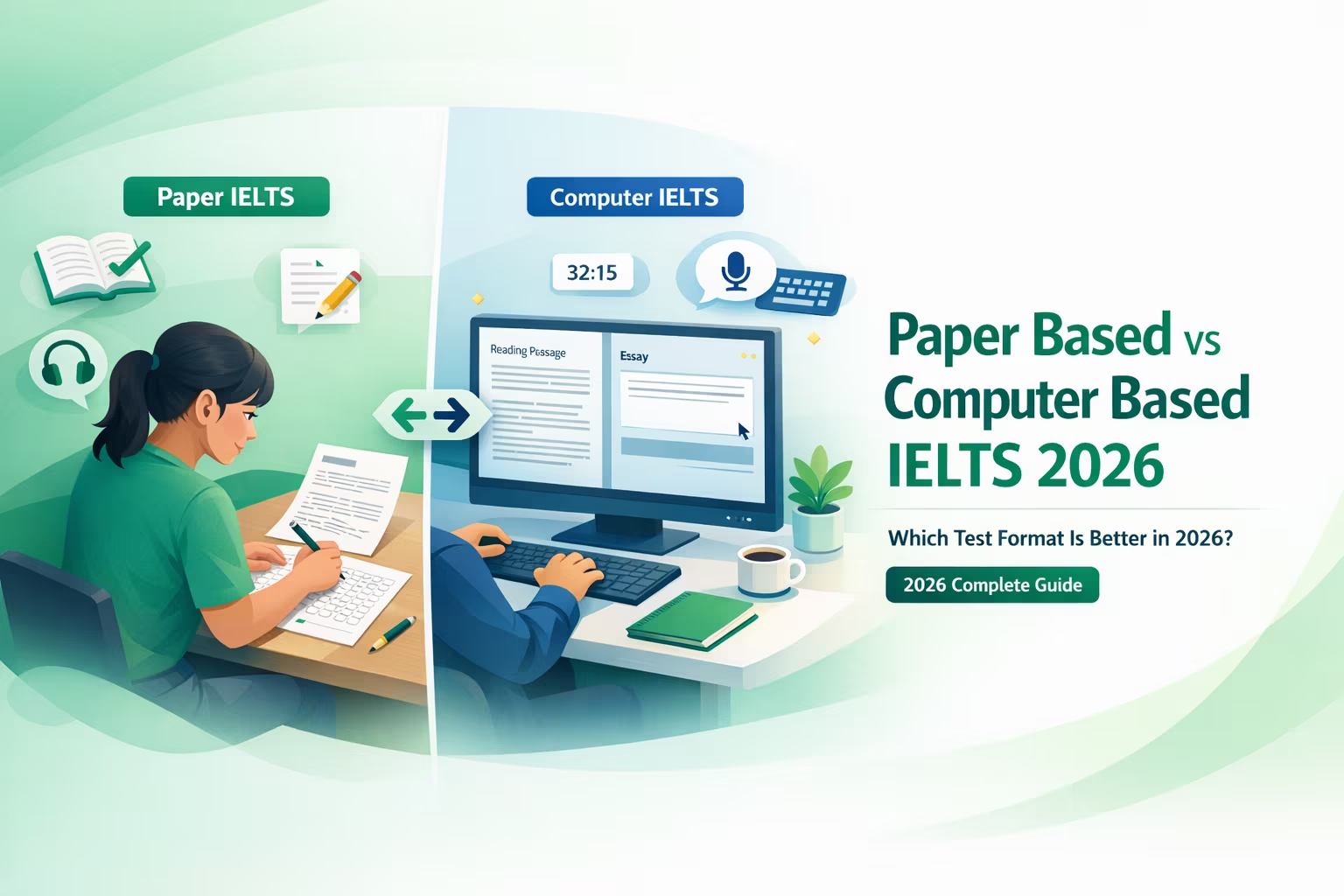
Paper Based vs Computer Based IELTS 2026: The Ultimate Decision Guide
Are you an international student planning to study abroad, but find yourself stuck deciding between the Paper Based vs Computer Based IELTS 2026? You are not alone. Every year, thousands of first-time test takers, especially from India and across the globe, face this exact dilemma. With the increasing digital shift in global education, understanding the nuances of the IELTS test types comparison is more critical than ever to securing that coveted high band score.
Let's clear the air immediately: both formats share the exact same difficulty level, question types, scoring rubrics, and content. The British Council and IDP IELTS ensure absolute fairness across both testing mediums. However, the delivery method you choose can drastically impact your personal comfort, time management, and ultimately, your final score.
Pro Tip: There is no "one size fits all." The best IELTS test format for students depends entirely on your daily habits—whether you spend more time typing on a laptop or writing in a notebook. Read on to discover which format aligns perfectly with your strengths.
What Are the Two IELTS Test Formats?
Before diving into which format is better for you, it is essential to understand exactly how each test operates in the real world. The IELTS exam preparation guide usually categorizes the test into two distinct delivery modes.
Paper-Based IELTS
- ✔The traditional exam format trusted for decades.
- ✔Candidates use an HB pencil to write answers on official answer sheets.
- ✔Reading, Listening, and Writing are conducted in a large examination hall.
- ✔The Speaking test is conducted face-to-face with a certified human examiner.
Computer-Based IELTS
- ✔The modern digital format growing rapidly in 2026.
- ✔Reading, Listening, and Writing sections are completed on a desktop computer.
- ✔Features the exact same scoring system and question types as paper.
- ✔Much faster result processing (typically within 3 to 5 days).
Paper Based vs Computer Based IELTS 2026 – Key Differences
To help you understand the core differences quickly, we have compiled a comprehensive feature comparison. Knowing the IELTS computer vs paper difference is the first step in optimizing your test strategy.
| Feature | Paper-Based IELTS | Computer-Based IELTS |
|---|---|---|
| Test format | Physical question booklets & answer sheets | Digital screen with keyboard and mouse |
| Writing method | Handwriting with HB pencil | Typing on a standard keyboard |
| Listening section | 10 extra minutes to transfer answers to sheet | No transfer time (2 mins to check answers) |
| Result time | 13 calendar days | 3 to 5 calendar days |
| Availability | Up to 4 times a month (Thursdays/Saturdays) | Multiple times a day, up to 7 days a week |
| Test experience | Large hall, page flipping, manual word count | Custom booth, screen tools, auto word count |
| Speaking Test | Identical. Face-to-face with a human examiner (sometimes via video call at the center). | |
IELTS Exam Structure 2026
Whether you search for the IELTS paper based exam format or the computer format, you will find that the core syllabus remains untouched. The assessment relies on four foundational pillars of English proficiency. Let's break down how each section functions across the two mediums:
1. Listening (30 Minutes)
You will listen to four recordings of native English speakers and answer 40 questions.
Paper Format: You write answers on the question paper while listening. At the end, you are given 10 minutes to transfer answers to an OMR sheet.
Computer Format: You type answers directly into the screen. Because of this, you do not get 10 transfer minutes at the end; instead, you get 2 minutes to review your typed answers. Headphones are universally provided.
2. Reading (60 Minutes)
Consists of 40 questions designed to test a wide range of reading skills across three long texts.
Paper Format: You flip between pages. You can use your pencil to physically underline keywords, circle dates, and make notes in the margins.
Computer Format: The screen is split into two halves: the text on the left and questions on the right. You can highlight text, leave digital sticky notes, and conveniently use `Ctrl+C` and `Ctrl+V` to copy-paste answers directly, avoiding spelling mistakes.
3. Writing (60 Minutes)
You must complete two tasks: Task 1 (150 words) and Task 2 (250 words essay).
Paper Format: Requires clear handwriting. If you make a mistake, you must erase it. You must also manually estimate your word count by counting lines.
Computer Format: Typing allows you to easily delete, rewrite, cut, and paste sentences. An on-screen automated word counter updates in real-time, removing the anxiety of not meeting the length requirements.
4. Speaking (11–14 Minutes)
This section remains sacred. IELTS believes that speaking is a human-to-human interaction. Therefore, whether you take the Paper Based vs Computer Based IELTS 2026, the speaking test is conducted face-to-face with a certified examiner in a private, quiet room.
Read our top IELTS Speaking Tips for 2026 →Advantages of Computer-Based IELTS
The IELTS computer based exam 2026 has surged in popularity, particularly among university students and IT professionals. Here is why many consider it the superior choice:
Lightning Fast Results
Need your scores for a tight university deadline? Computer-delivered results are published in just 3 to 5 days, compared to the agonizing 13-day wait for paper.
Effortless Writing & Editing
Say goodbye to messy erasures. You can easily restructure your essay, insert sentences in the middle of a paragraph, and monitor your exact word count on screen.
Smart Highlighting Tools
The split-screen in the Reading section means no page flipping. You can highlight text digitally and copy-paste keywords straight into the answer box.
Unmatched Date Flexibility
Computer-based tests are conducted multiple times a day, up to 7 days a week in major cities. You can easily book a slot that perfectly fits your schedule.
Advantages of Paper-Based IELTS
Despite the digital revolution, the paper format holds strong. Many top-scoring candidates still swear by it. Here is why traditional remains powerful:
Familiar Writing Style
If you have spent 15+ years of your academic life writing exams on paper, muscle memory kicks in. Thoughts often flow better from brain to pen for many students.
Zero Screen Fatigue
Staring at a harsh monitor for nearly 3 hours can cause eye strain, headaches, and a loss of concentration. Printed pages are inherently more comfortable for extended reading.
Better Listening Mapping
You get 10 extra minutes at the end of the Listening test. This allows you to quickly jot rough answers during the audio and carefully transfer them later with correct spelling.
No Tech Anxiety
Some candidates worry about keyboard malfunctions, noisy typists in the cubicle next to them, or adjusting to an unfamiliar operating system.
Which IELTS Test Is Easier in 2026?
A common question we receive is: "Which IELTS test is easier paper or computer?"
The absolute truth is: Neither test is inherently easier. The Cambridge Assessment English board meticulously designs both formats to be statistically identical in difficulty. A Band 8.0 on Paper is exactly equal to a Band 8.0 on Computer.
The perceived "easiness" is purely subjective. It relies entirely on your personal comfort zones:
- Typing Speed vs. Handwriting Speed: If you type faster than 35-40 words per minute (WPM), the computer test will feel effortless. If you struggle to find keys on a keyboard, the paper test will be far less stressful.
- Reading Comfort Level: Do you read news on your tablet, or do you prefer physical books? Your stamina for reading on a screen dictates your performance in the brutal 60-minute Reading section.
- Spatial Organization: Some students need to draw arrows, cross out eliminated options with a pencil, and physically interact with the text to understand complex passages.
How to Choose the Right IELTS Test Format
Still undecided? Use this simple, actionable decision checklist to determine the right path for your 2026 application journey.
💻 Choose Computer-Based If:
- ✓You are a touch-typist and can type over 40 words per minute without looking at the keyboard.
- ✓Your university deadline is fast approaching and you need results in under 5 days.
- ✓You consume most of your daily reading material (blogs, news, PDFs) on digital screens.
- ✓Your handwriting is messy or illegible when you write quickly under time pressure.
📝 Choose Paper-Based If:
- ✓You prefer traditional handwriting and have clear, readable cursive or print.
- ✓You find it difficult to focus on a glowing monitor for three continuous hours.
- ✓You rely heavily on physically underlining sentences and scribbling margin notes.
- ✓You are not comfortable typing long essays and tend to make frequent typos.
IELTS Preparation Tips for Both Test Formats
Now that you have hopefully chosen your format, how do you conquer it? Here are top IELTS test tips 2026 mapped to your specific medium.
For Computer-Based Candidates
- Improve Typing Speed: Practice typing essays on sites like 10fastfingers. Aim for accuracy over raw speed to avoid spell-check penalties.
- Use Official Screen Mockups: Practice IELTS Reading Practice Tests using the official IDP/British Council familiarization UI so the split-screen doesn't surprise you.
- Master Screen Reading: Force yourself to read long articles from BBC News or National Geographic on your desktop without printing them.
For Paper-Based Candidates
- Use Cambridge Books: Purchase the official Cambridge physical test books. Practice exclusively with an HB pencil.
- Time Management: Practice manually counting your essay words. Learn what 250 words looks like in your specific handwriting to save counting time on test day.
- Transfer Practice: Never skip practicing the 10-minute answer transfer in the Listening section. Many students lose marks due to shifting answers on the OMR sheet.
Universal Tip: Regardless of the format, practice speaking regularly. Record your voice, listen for grammatical errors, and familiarize yourself with 2026 cue card topics!
Conclusion
Deciding between the Paper Based vs Computer Based IELTS 2026 should not be a source of anxiety. As we have explored, both formats are fully valid, internationally recognized, and completely identical in terms of academic rigor and assessment criteria.
If you thrive in the digital ecosystem, enjoy quick typing, and demand fast results, the computer-based test is your champion. Conversely, if the tactile feel of a pencil and paper calms your nerves and helps you focus deeply on complex texts, the traditional paper-based format remains a steadfast and reliable option.
The most critical step now is to make your choice and align your preparation strategy to that specific medium. Start taking mock tests early, simulate real exam conditions, and you will confidently achieve your desired band score!