
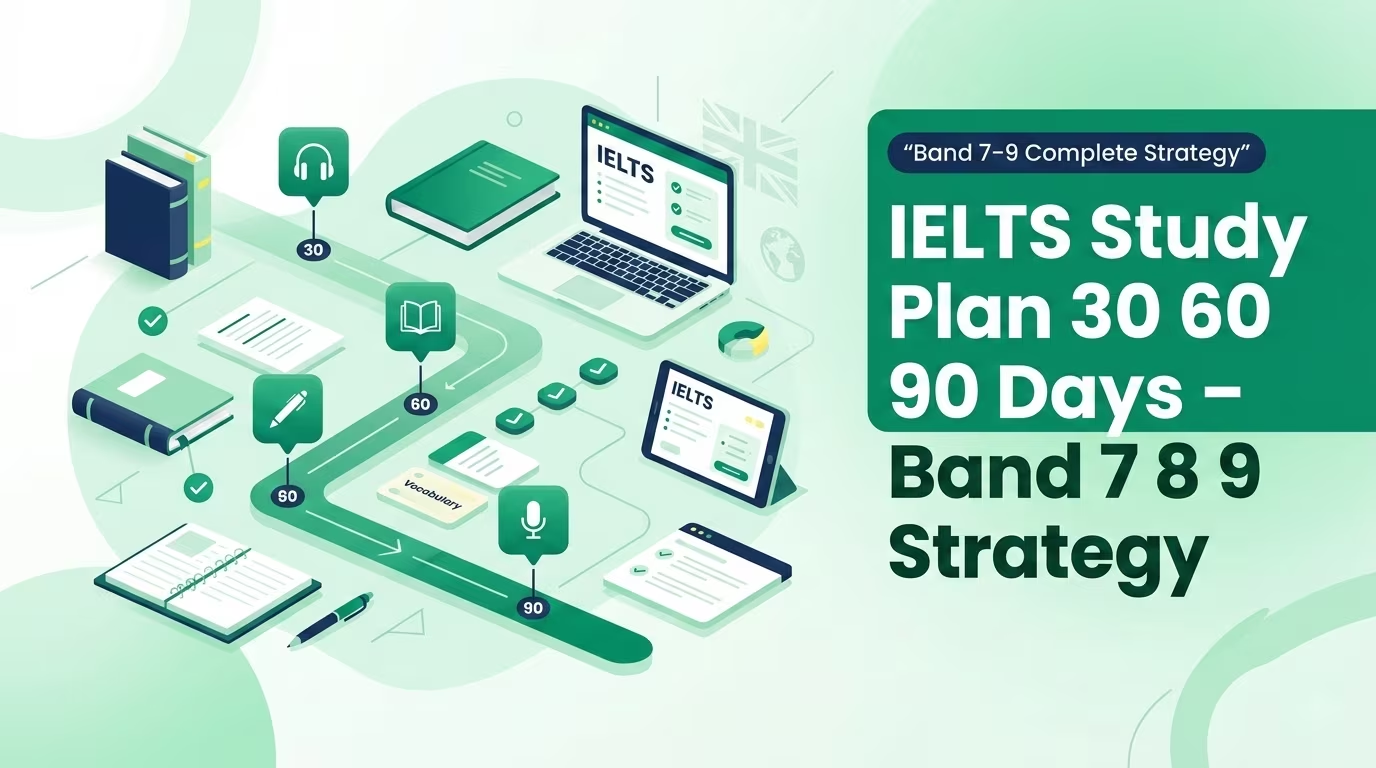
The Ultimate IELTS Study Plan 30 60 90 Days Band 7 8 9
Are you an Indian student aiming for top universities in the UK, Canada, or Australia? Crafting the perfect IELTS Study Plan 30 60 90 Days Band 7 8 9 is your blueprint for success. Whether you are a working professional or a self-study candidate, a structured approach is non-negotiable for conquering the International English Language Testing System (IELTS).
Preparing for the IELTS exam in 2026 requires more than just passive reading; it demands a strategic, highly structured IELTS preparation strategy. Many test-takers struggle because they lack a clear roadmap. They consume random YouTube videos, download countless PDFs, but fail to implement a consistent IELTS daily study routine. This comprehensive guide will break down exactly how you can tailor your preparation based on the time you have available.
The IELTS exam evaluates your proficiency across four critical pillars: Listening, Reading, Writing, and Speaking. Depending on your current baseline of English proficiency, you might need a rapid 1-month sprint or a comprehensive 3-month marathon. Our expert-curated plans are designed to help you achieve a Band 7, Band 8, or even the elusive Band 9, providing you with actionable daily targets, premium resource recommendations, and proven test-taking strategies.
🎯Understanding IELTS Band Scores (7, 8, and 9)
Before diving into your chosen IELTS Study Plan 30 60 90 Days Band 7 8 9, you must understand what your target score signifies to examiners and admission committees. The IELTS grading system spans from Band 1 (Non-user) to Band 9 (Expert user). For premier global study abroad destinations, a minimum of Band 6.5 is standard, but elite institutions and competitive visa categories (like Canadian PR) often demand a 7.0 or higher.
| Band Score | Skill Level | What This Means for You |
|---|---|---|
| Band 7.0 | Good User | You have operational command of the language, despite occasional inaccuracies. This is the gold standard for most Master's programs and professional registrations globally. |
| Band 8.0 | Very Good User | You handle complex argumentation well. Achieving an 8, especially in Listening and Reading, significantly boosts your overall average, making your profile stand out for Ivy League or Oxbridge admissions. |
| Band 9.0 | Expert User | You show complete understanding, accuracy, and fluency. While rare, scoring a 9 in Reading or Listening is highly achievable with the right 90-day mastery plan and rigorous practice. |
⚡IELTS Study Plan: 30 Days (Fast Track)
An IELTS preparation plan 30 days is ideal for candidates who already possess a strong foundation in English. If you can comfortably read broadsheet newspapers, watch English movies without subtitles, and write clear emails, this 4-week sprint is for you. The focus here is not on learning English from scratch, but on mastering the IELTS test format, time management, and specific question types.
Week 1: Format Familiarization
- ✔ Understand the 4 sections inside out.
- ✔ Take your first diagnostic mock test to find weak areas.
- ✔ Learn skimming and scanning for Reading.
Week 2: Deep Dive into Skills
- ✔ Focus on Writing Task 1 & Task 2 structures.
- ✔ Practice Listening part 3 & 4 (the hardest parts).
- ✔ Record yourself for Speaking Part 2 for 2 minutes daily.
Week 3: Intense Mock Testing
- ✔ Complete full-length practice tests under strict timing.
- ✔ Get your Writing essays evaluated by an expert or AI tool.
- ✔ Identify recurring traps in True/False/Not Given questions.
Week 4: Refinement & Rest
- ✔ Review all past mistakes; do not attempt new material.
- ✔ Polish vocabulary for high-frequency IELTS topics.
- ✔ Ensure adequate sleep before the exam day.
⚖️IELTS Study Plan: 60 Days (Balanced)
An IELTS study plan 60 days is the most recommended timeline for the majority of Indian students and working professionals. Two months allow you to balance your daily job or university classes with your IELTS self-study plan. It provides ample time to genuinely improve your grammar and vocabulary, rather than just learning test tricks.
The 8-Week Breakdown
Weeks 1 & 2: Grammar & Vocabulary Base
Focus on complex sentence structures, linking words, and topic-specific vocabulary (Environment, Education, Technology). Begin daily reading of academic articles.
Weeks 3 & 4: Receptive Skills (Read & Listen)
Master active listening techniques. Learn to predict answers. For reading, conquer the matching headings and multiple-choice question formats. 2 hours of daily practice.
Weeks 5 & 6: Productive Skills (Write & Speak)
Write one essay daily. Learn the PEEL (Point, Evidence, Explain, Link) paragraph structure. Practice Speaking Parts 1, 2, and 3 with a study partner or tutor.
Weeks 7 & 8: Exam Simulation
Take a full 2-hour 45-minute test every alternate day at the exact time of your actual exam. Build stamina and focus entirely on error correction.
🎓IELTS Study Plan: 90 Days (Complete Mastery)
If your target is to figure out exactly how to get band 8 in IELTS or even band 9, the IELTS study plan 90 days provides the rigorous timeline needed for complete mastery. This is also the ideal track for beginners whose current English level is around Band 5.0-5.5. A 3-month window ensures you transform your foundational language skills before testing them.
Month 1: The Foundation Phase
Dedicate this entire month to immersion. Do not touch official IELTS test papers yet. Read international news (BBC, The Economist). Listen to English podcasts daily. Start a vocabulary journal where you document 10 new words daily alongside synonyms, antonyms, and example sentences.
Month 2: The Strategy Phase
Now, transition to the official Cambridge IELTS books (Books 15 to 19). Dissect every single question type. Spend an entire week on just Reading strategies. Learn how to map ideas for IELTS Writing Task 2. Aim for untimed practice—focus on accuracy over speed.
Month 3: The Performance Phase
Introduce the stopwatch. Speed is your main opponent now. Dedicate your IELTS daily study routine to completing timed sections. Focus heavily on identifying *why* you got an answer wrong. Keep an "error log" spreadsheet. Engage in intensive mock speaking interviews.
⏱️The Ultimate IELTS Daily Study Routine
Consistency beats intensity. A well-structured IELTS daily study routine of 2 to 3 hours is vastly superior to studying 10 hours on a Sunday. Here is a high-performance daily schedule designed for Indian test-takers balancing college or work:
🌅 Morning Routine (1 Hour)
- 30 Mins: Listening. Listen to a TED Talk or BBC 6 Minute English. Focus on accents and intonation.
- 30 Mins: Reading. Read an editorial. Highlight complex vocabulary and summarize the main idea in your own words.
🌆 Evening Routine (1.5 Hours)
- 45 Mins: Writing. Alternate days between Task 1 (Data description) and Task 2 (Essay). Practice brainstorming for 5 minutes before writing.
- 30 Mins: Speaking. Answer 3 part-one questions and one part-two cue card. Record and self-evaluate.
- 15 Mins: Vocab Review. Review your vocabulary journal before sleeping.
📚Best Resources for IELTS Preparation
A successful IELTS preparation strategy India relies heavily on utilizing official, high-quality materials. Avoid unverified internet PDFs that contain outdated or grammatically incorrect questions.
- 1Cambridge Official IELTS Practice Materials (Books 11 to 19)These are authentic past papers. Treat them as gold. Do not waste them early in your prep.
- 2Official IELTS WebsitesLeverage free resources from British Council and IDP IELTS to understand the latest scoring rubrics.
- 3Digital Learning HubsFor visual learners, high-quality YouTube channels and dedicated platforms offering IELTS Speaking Guides can simulate real exam conditions.
🚀Pro Tips to Achieve Band 7, 8, or 9
Wondering exactly how to get band 9 in IELTS? It comes down to lexical resource, grammatical range, coherence, and pronunciation.
1. Paraphrasing is Your Superpower
In all four modules, the examiner wants to see if you can say the same thing in different ways. If the reading text says "rapidly increased," the question might say "soared." In writing, never copy the prompt—always paraphrase the introduction.
2. Master Complex Grammar Sparingly
To score a Band 8 in grammar, you must use a mix of simple and complex sentences (conditionals, passive voice, relative clauses). However, accuracy beats complexity. Do not force a complex sentence if you are unsure of its grammatical correctness.
3. Coherence and Cohesion Over Fancy Words
Many students ruin their essays by stuffing them with "big words" they barely understand. Band 8+ writing relies heavily on logical flow. Use linking words (Furthermore, Consequently, Admittedly) correctly to guide the reader seamlessly.
⚠️Common IELTS Preparation Mistakes to Avoid
Examiners are highly trained to spot memorized templates. This will result in an automatic penalty, often dropping your writing score to a Band 5.0.
Writing 350 words for Task 2 leaves you prone to grammar mistakes and eats up your time. Stick to 260-280 words of high-quality, concise argumentation.
Just checking your answers against the key isn't studying. You must analyze *why* the answer was C and not A. Understanding the trap is how you improve.
Fluency is not speed. Speaking too quickly ruins your pronunciation and intonation. Speak at a measured, confident pace to allow for clear enunciation.
🧠Using AI Feedback in Your Study Cycle (2026)
The single biggest change to the way candidates can prepare for IELTS in 2026 is the availability of detailed AI feedback on every full-length practice test. Earlier study plans had to assume that you would self-grade or wait for a paid expert to review your Writing and Speaking. With the feedback now generated automatically on /ielts-full-test — and as a free opt-in on every standalone Reading and Listening test — the practical loop between practice, feedback, and targeted study can compress from days to under an hour.
Here is how to slot AI-feedback review into each phase of the 30, 60, and 90-day plans above:
- 30-day plan: sit one full mock at day 1 and again at day 21. The first feedback report tells you which of the four sections needs the most work; the second tells you whether the targeted practice between them moved the needle. Most candidates in this window cannot afford the cost of a third full mock, so make these two count.
- 60-day plan: sit a full mock every two weeks (four mocks total). Use the per-question type breakdown to choose your weakest type each fortnight, then drill that type with three to five focused section tests before the next mock. Pay particular attention to the near-miss spelling tags on Listening — these are recovered with spelling rote drills, not with more Listening practice.
- 90-day plan: sit a full mock weekly for the first eight weeks, then every five days for the final fortnight. The Writing and Speaking feedback at this cadence catches developing habits before they become ingrained; the Reading and Listening feedback shows you whether the changes you are making are actually moving question-type accuracy or just shuffling errors around.
A useful rule across all three plans: do not accept a feedback report passively. After every mock, write down three concrete actions you will take before the next sitting — the weakest question type to drill, the highest-impact vocabulary group from the topic vocabulary pages to memorise, and one specific Writing or Speaking habit to change. Without that translation step, the feedback report is just diagnostic — it has to become a plan before it can lift your band.
Tracking your band-lift target across sittings is the most reliable predictor of test-day performance. Most successful candidates we observe move 0.5 to 1.0 band over a 60-day plan when they use feedback this way, with the largest gains in Listening (because spelling/format errors are fixable) and Writing Task 2 (because structural feedback produces fast Coherence & Cohesion gains).
Conclusion: Your Journey to Global Education
Securing a high score on the IELTS is not about possessing innate linguistic genius; it is entirely about smart strategy, relentless consistency, and utilizing the right framework. By faithfully adopting our IELTS Study Plan 30 60 90 Days Band 7 8 9, you are taking the guesswork out of your preparation.
Whether you choose the 30-day fast track, the 60-day balanced routine, or the comprehensive 90-day mastery plan, remember that every hour of focused practice brings you one step closer to your dream university in the UK, Canada, or Australia. Bookmark this guide, set up your study desk, and start your day 1 today. Your global future awaits!
Start Your IELTS Prep Journey Now