
IELTS Syllabus 2026: Complete Section-Wise Breakdown
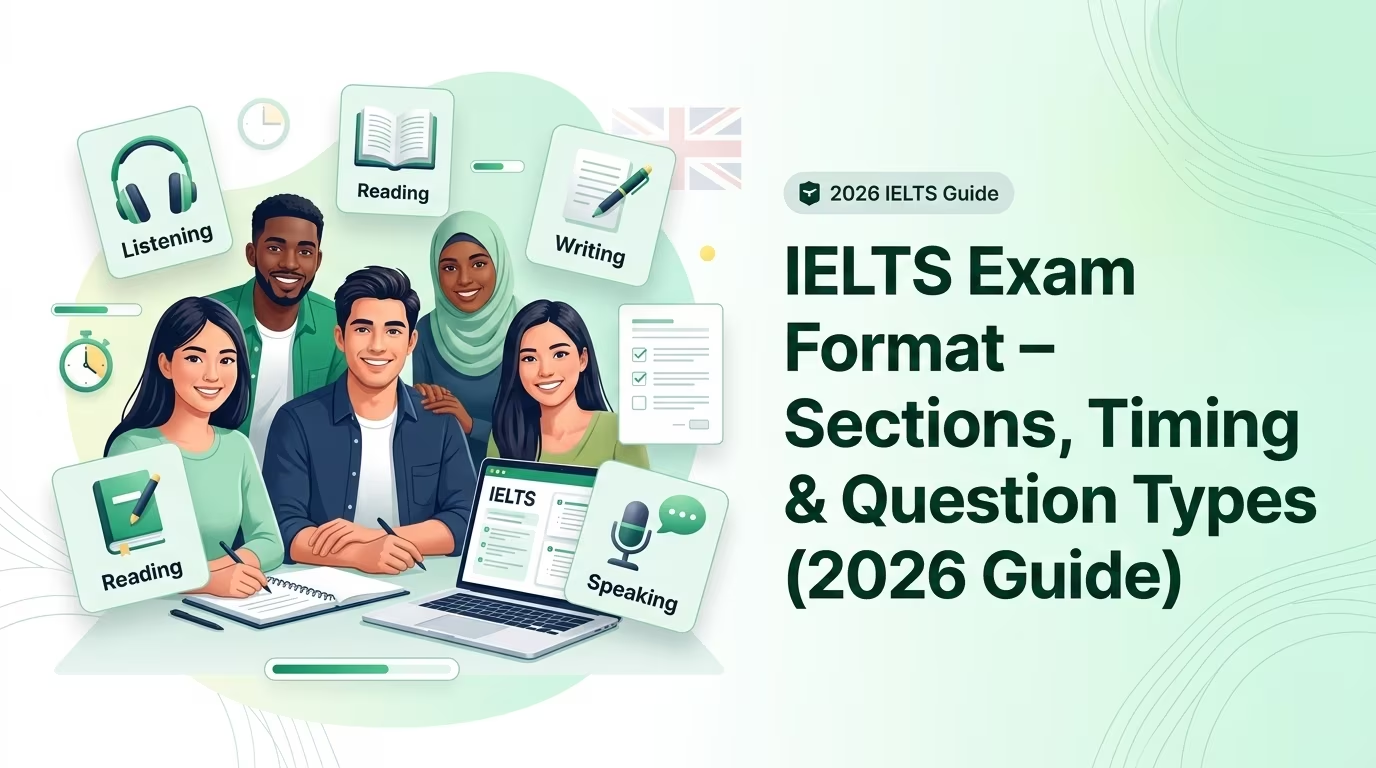
The IELTS syllabus covers four skills — Listening, Reading, Writing and Speaking — tested in 2 hours 45 minutes. Listening and Speaking are identical for Academic and General Training. Reading and Writing Task 1 differ between the two. There is no fixed content list to memorise: IELTS tests English ability, not subject knowledge.
Most pages that claim to list the “IELTS syllabus” simply restate the exam timetable. That is not very useful when you are deciding what to actually study. This guide sets out what each section genuinely asks of you — every question type, every word count, every time limit — and then shows, using real scored attempts from this site, which parts of that syllabus candidates struggle with most.
One thing to settle immediately, because it causes a lot of wasted effort: IELTS has no prescribed syllabus in the way a school subject does. There is no set vocabulary list, no grammar curriculum and no reading list. The examiners are measuring how well you use English under timed conditions. So “studying the syllabus” means learning the format thoroughly and then improving the underlying skill each format tests.
What does the IELTS exam pattern look like?
IELTS has four sections taken in one sitting: Listening (30 minutes, 40 questions), Reading (60 minutes, 40 questions), Writing (60 minutes, 2 tasks) and Speaking (11–14 minutes, 3 parts). Total test time is 2 hours 45 minutes. Speaking may be scheduled up to a week either side of the other three.
| Section | Time | Questions | Structure | Academic vs General |
|---|---|---|---|---|
| Listening | 30 minutes (+10 min transfer on paper) | 40 | 4 recordings | Identical for Academic and General Training |
| Reading | 60 minutes | 40 | 3 passages / 3 sections | Different texts for Academic and General Training |
| Writing | 60 minutes | 2 tasks | Task 1 + Task 2 | Task 1 differs; Task 2 is an essay in both |
| Speaking | 11–14 minutes | 3 parts | Interview, long turn, discussion | Identical for Academic and General Training |
The order on test day is fixed: Listening, then Reading, then Writing, with no breaks between them. That matters more than it sounds. You sit Writing — the section that needs the most sustained concentration — after already working for 90 minutes. Practising the three back to back at least once before test day is worth more than another vocabulary list.
If you want the timing and question types broken down screen by screen rather than section by section, our IELTS exam format guide walks through the test in the order you actually sit it.
What is the IELTS Listening syllabus?
IELTS Listening has four parts and 40 questions, played once only. Parts 1 and 2 cover everyday social situations; Parts 3 and 4 cover education and training. On paper you get 10 extra minutes to transfer answers; on computer you get 2 minutes to check.
| Part | Context | Typical example |
|---|---|---|
| Part 1 | Everyday conversation between two speakers | Booking accommodation, joining a gym, ordering a service |
| Part 2 | Everyday monologue, one speaker | A tour guide describing facilities, a talk on local services |
| Part 3 | Educational discussion, up to four speakers | Two students and a tutor discussing an assignment |
| Part 4 | Academic monologue, one speaker | A university lecture on a single subject |
A range of native-speaker accents appears across the four parts — British, Australian, North American and New Zealand. The recording plays once, so the real skill being tested is holding your place while predicting what is coming next. Spelling and grammar count: a correct answer written incorrectly scores nothing.
Listening uses one conversion table for both test variants — see IELTS Listening band score for how many of the 40 marks each band needs.
You can work through full recordings under exam timing on our free IELTS Listening practice tests, which use the same four-part structure.
What is the IELTS Reading syllabus?
IELTS Reading gives you 60 minutes for 40 questions with no extra transfer time. Academic uses three long passages from books and journals. General Training uses everyday and workplace texts across three sections. Both are marked out of 40.
| Variant | Structure | Text sources | Style |
|---|---|---|---|
| Academic | 3 long passages, increasing in difficulty | Books, journals, magazines and newspapers | Descriptive, factual, discursive or analytical |
| General Training | Section 1 (2–3 short texts), Section 2 (2 texts), Section 3 (1 long text) | Notices, advertisements, handbooks, company material | Everyday survival English, then work-related, then general interest |
The absence of transfer time is the single most under-appreciated fact in the Reading syllabus. Sixty minutes means sixty minutes including writing your answers on the answer sheet. Candidates who plan for “60 minutes of reading” routinely lose several marks they had already worked out.
Try a timed passage set on our free IELTS Reading practice tests, and compare your raw score against the official conversion in our IELTS band score calculator. For the full Academic and General Training conversion tables, see IELTS Reading band score — General Training needs noticeably more correct answers than Academic for the same band.
What question types are in the IELTS syllabus?
IELTS uses around eleven question types across Listening and Reading. Six appear in both sections. Three — True/False/Not Given, Yes/No/Not Given and matching headings — appear only in Reading, and they account for a large share of lost marks.
| Question type | Listening | Reading | What it tests |
|---|---|---|---|
| Multiple choice | Yes | Yes | One answer from three or more options, or several from a longer list. |
| Matching | Yes | Yes | Match items to a list of options, often features or people. |
| Plan, map or diagram labelling | Yes | Yes | Label a visual using words from the recording or passage. |
| Form, note, table, flow-chart or summary completion | Yes | Yes | Fill gaps within a strict word limit, usually one to three words. |
| Sentence completion | Yes | Yes | Complete a sentence using words from the source text. |
| Short-answer questions | Yes | Yes | Answer using words taken directly from the source. |
| True / False / Not Given | No | Yes | Reading only. Decide whether a statement matches the passage. |
| Yes / No / Not Given | No | Yes | Reading only. Tests the writer's claims and opinions. |
| Matching headings | No | Yes | Reading only. Match a heading to each paragraph. |
If you only have time to drill one type, make it True/False/Not Given. The distinction between “False” (the passage contradicts the statement) and “Not Given” (the passage is silent on it) is where careful readers lose marks by over-thinking. Our free Learn IELTS course has a lesson with interactive practice for each individual question type.
What is the IELTS Writing syllabus?
IELTS Writing is 60 minutes for two tasks. Task 1 needs at least 150 words in about 20 minutes; Task 2 needs at least 250 words in about 40 minutes. Task 2 is worth double Task 1 in the final Writing band, so it should get the larger share of your time.
| Task | Suggested time | Minimum words | What you must do |
|---|---|---|---|
| Task 1 — Academic | About 20 minutes | At least 150 | Describe a graph, chart, table, diagram, map or process in your own words. |
| Task 1 — General Training | About 20 minutes | At least 150 | Write a letter — formal, semi-formal or personal — to request, explain or complain. |
| Task 2 — both variants | About 40 minutes | At least 250 | Write an essay responding to an argument, problem or point of view. |
Both tasks are marked on four equally weighted criteria: Task Achievement (or Task Response for Task 2), Coherence and Cohesion, Lexical Resource, and Grammatical Range and Accuracy. Writing under the minimum word count is penalised directly, so the 150 and 250 figures are floors, not targets.
Because Task 2 counts double, the arithmetic is worth internalising: a band 7 essay with a band 5 Task 1 gives a Writing band of roughly 6.5, whereas the reverse gives roughly 5.5. See worked examples in our IELTS Writing sample answers and the Task 1 chart-type guides.
What is the IELTS Speaking syllabus?
IELTS Speaking is an 11–14 minute face-to-face interview in three parts: a personal interview, a 1–2 minute long turn from a cue card with one minute of preparation, and an abstract discussion. It is identical for Academic and General Training.
| Part | Length | What happens |
|---|---|---|
| Part 1 — Introduction and interview | 4–5 minutes | Questions about yourself: home, work, study, hobbies and familiar topics. |
| Part 2 — Long turn | 3–4 minutes | A cue card with 1 minute to prepare, then speak for 1–2 minutes, plus a follow-up question. |
| Part 3 — Discussion | 4–5 minutes | Abstract questions connected to the Part 2 topic, in a two-way discussion. |
Speaking is assessed on Fluency and Coherence, Lexical Resource, Grammatical Range and Accuracy, and Pronunciation. There is no “correct” opinion — the examiner is listening to how you express it, not whether they agree. Practise the long turn with our IELTS cue card library and the common Part 1 topic questions.
How does the Academic syllabus differ from General Training?
Only Reading and Writing Task 1 differ. Listening and Speaking are completely identical. Academic Reading uses long academic passages and Task 1 describes visual data; General Training uses everyday and workplace texts and Task 1 is a letter. General Training Reading also needs more correct answers for the same band.
| Area | Same or different? | Detail |
|---|---|---|
| Listening | Identical | Same recordings, same 40 questions. |
| Speaking | Identical | Same three-part format and same assessment criteria. |
| Reading | Different | Academic uses three long academic passages; General Training uses workplace and everyday texts. |
| Writing Task 1 | Different | Academic describes visual data; General Training writes a letter. |
| Writing Task 2 | Same format | An essay in both, though Academic prompts tend to be more abstract. |
| Band conversion | Different | General Training Reading needs more correct answers for the same band. |
Choose the variant your destination requires, not the one that sounds easier. Academic is normally required for university study and professional registration; General Training is used for migration to the UK, Australia, Canada and New Zealand, and for secondary education or work experience. A fuller comparison is in our Academic vs General Training guide.
How is the IELTS syllabus scored?
Each section is scored 0–9 in half bands. Listening and Reading convert a raw score out of 40 into a band. Writing and Speaking are marked by examiners against four criteria each. The overall band is the average of the four, rounded to the nearest half band.
Rounding works in your favour more often than candidates expect. An average ending in .25 rounds up to the next half band, and one ending in .75 rounds up to the next whole band. So 6.5, 6.5, 6.0, 6.0 averages 6.25 and is reported as 6.5, not 6.0.
There is no pass mark. What counts as a good result depends entirely on what your university or visa route requires — most undergraduate courses sit around 6.0–6.5, postgraduate around 6.5–7.0, and skilled migration often demands 7.0 in every section. You can convert raw scores yourself with our IELTS band score calculator, or read the full breakdown in our band score guide.
Which part of the syllabus do candidates find hardest?
Across 5,110 scored practice attempts on this site, Reading produced the lowest average band (3.91) and Writing the highest (5.14). Only 18.2% of Speaking attempts reached band 6, and just 0.2% reached band 7 — the hardest ceiling of any section.
| Section | Attempts scored | Average band | Reached band 6+ | Reached band 7+ |
|---|---|---|---|---|
| Listening | 2861 | 4.82 | 32.9% | 5.7% |
| Reading | 2236 | 3.91 | 24.2% | 8.3% |
| Writing | 1886 | 5.14 | 29.6% | 10.7% |
| Speaking | 2004 | 4.75 | 18.2% | 0.2% |
Two patterns are worth acting on. First, Speaking has the hardest ceiling — only 5 of 2,004 Speaking attempts (0.2%) reached band 7, against 5.7% in Listening, 8.3% in Reading and 10.7% in Writing. Its average is mid-range, so this is not a section people are simply bad at; it is the section where getting from competent to strong is hardest.
Second, Reading has the widest spread. It produced the lowest average of any section (3.91) yet still the second-highest rate of band 7+ results (8.3%). That is the signature of a timing problem rather than a comprehension problem: candidates who have a working strategy do well, and those who do not run out of time.
Method: anonymised aggregate of scored submissions on this site as of 14 August 2026, excluding only the 79 attempts submitted with no content at all. Genuine zero scores are included — excluding them, as an earlier version of this table did, overstates every average. Practice conditions are not exam conditions, and our users skew towards early-stage preparation, so treat these as relative signals between sections rather than predictions of your own result.
How should you study the IELTS syllabus?
Sit one full timed mock first to find which section is actually holding you back, then spend most of your study time there. Learning the format of every question type is a matter of days; improving the underlying skill takes weeks, so do not spend the weeks on the days.
A sensible order of work follows directly from the syllabus itself:
- Take a full mock under real timing. Listening, Reading and Writing back to back, no breaks. Our free full IELTS mock test mirrors the exam order.
- Learn the question types cold. Knowing on sight whether something is a matching-headings or a summary-completion task saves time you currently spend deciding.
- Fix timing before technique. Especially in Reading, where there is no transfer time.
- Practise Speaking out loud. On our data it is the weakest and least-practised section by a clear margin.
- Re-test every two weeks. Band movement is the only reliable evidence that a study method is working.
Every section above can be practised free on this site, with band scores and examiner-style feedback returned automatically — start with a free IELTS practice test or work through the structured Learn IELTS course lesson by lesson.