
IELTS Speaking Vocabulary: Band 9 Phrases, Idioms & Fillers
In IELTS Speaking, vocabulary is graded live as Lexical Resource — 25% of your band. But the examiner is not counting rare words. They are listening for natural phrases, correct collocations and the occasional idiomatic expression that fits the moment.
That is good news, because spoken English runs on a fairly small set of reusable phrases. This guide gives you a working bank for each part of the test — Part 1 small talk, the Part 2 long turn, and Part 3 discussion — plus the idioms worth knowing, the fillers that replace silence, and the collocations that separate band 6 from band 7+.
What examiners actually listen for
- Flexibility, not performance. Vocabulary that adapts to the actual question scores; a memorised “advanced” monologue delivered regardless of the question is marked down across criteria.
- Less common items used naturally. One well-placed “it was a double-edged sword” does more than five forced rare words.
- Paraphrase under pressure. When you lack a word, talking around it smoothly (“the machine that measures your heart rate”) is itself rewarded as a lexical skill.
- Collocation accuracy. “Heavy traffic”, “take up a hobby”, “a rewarding job” — natural partnerships signal real fluency.
Phrase banks for Speaking Parts 1, 2 and 3
Part 1 — familiar questions
Short, natural answers about your life. The skill is extending an answer by one reason or example without sounding rehearsed.
To be honest, ...
Softens an opinion: “To be honest, I’m not much of a cook.”
I’d say ...
Natural opinion opener: “I’d say I read two or three books a month.”
It depends on ...
Shows flexibility: “It depends on the season — in summer I cycle everywhere.”
I’m really into ...
Informal enthusiasm: “I’m really into photography at the moment.”
Now and then / once in a while
Frequency without repeating “sometimes”.
Part 2 — the long turn
Two minutes on a cue card. You need narrative connectors that keep you moving and buy thinking time mid-story.
The first thing that comes to mind is ...
Strong, natural opening line for almost any cue card.
What made it so memorable was ...
Pivots from describing to explaining — where band 7+ answers live.
Looking back, ...
Adds reflection: “Looking back, it changed how I think about money.”
I remember vividly that ...
Signals detail is coming; stronger than “I remember”.
Anyway, to cut a long story short, ...
Rescues you when time is running out — and sounds native doing it.
Part 3 — abstract discussion
Opinion, speculation and comparison. This is where examiners listen hardest for less common vocabulary used precisely.
That’s a tricky one, but I suppose ...
Buys time legitimately while signalling you understood the question.
Broadly speaking, ...
Frames a generalisation you are about to qualify.
There’s a growing tendency for people to ...
Discusses trends: “...a growing tendency for people to shop online.”
The main downside, as I see it, is ...
Evaluates while marking the opinion as yours.
If this trend continues, I imagine ...
Speculation about the future — a classic Part 3 requirement.
To practise these against real, current questions, use the latest Speaking cue cards with band 9 sample answers, then record yourself in a free IELTS Speaking practice test to get scored feedback on your Lexical Resource.
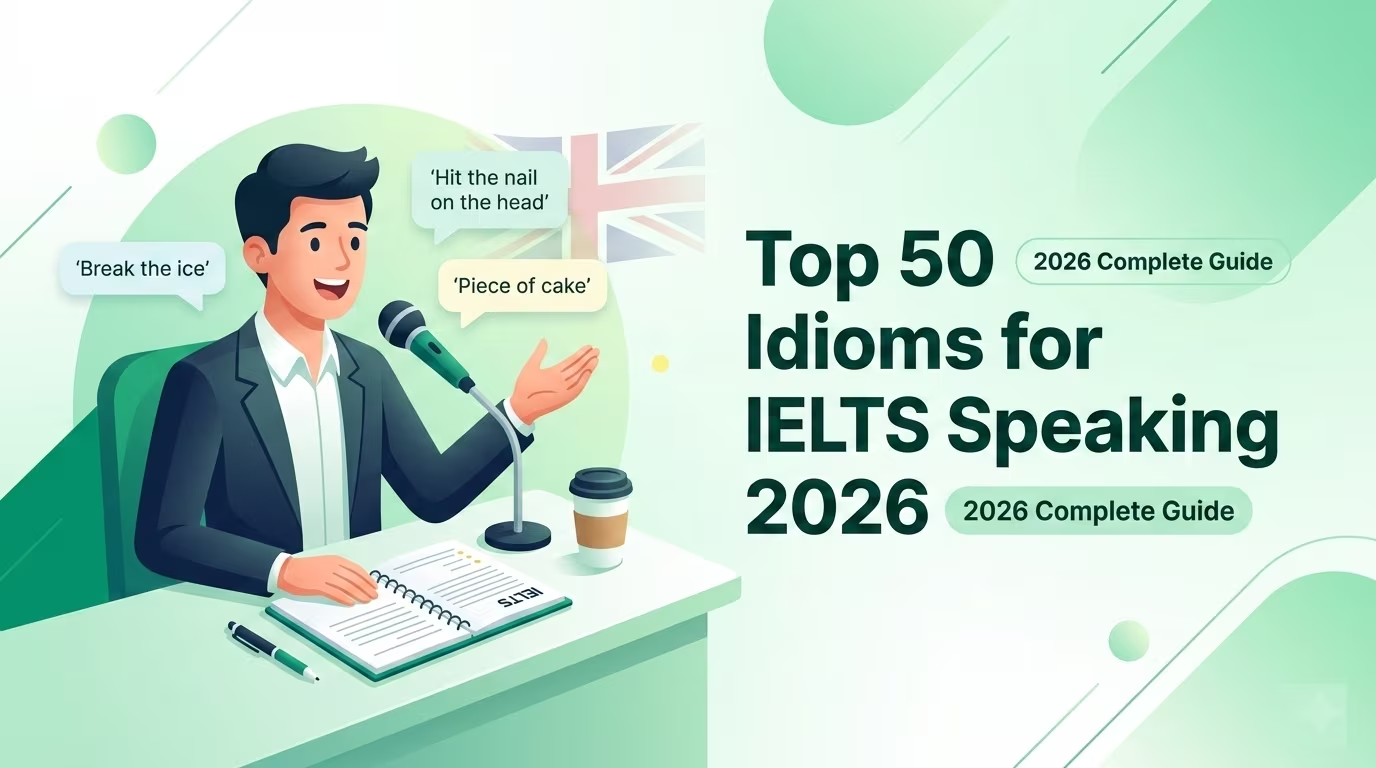
Idioms that actually score (and how to use them)
Idiomatic language appears explicitly in the band 7+ descriptors. The rule: one or two idioms, used where they genuinely fit, in Part 1 or Part 2. Forcing idioms into Part 3 analysis usually sounds unnatural.
| Idiom | Meaning | In an answer |
|---|---|---|
| over the moon | extremely happy | I was over the moon when I got my exam results. |
| once in a blue moon | very rarely | We eat out once in a blue moon, usually for birthdays. |
| a double-edged sword | something with advantages and disadvantages | Social media is a double-edged sword for teenagers. |
| find my feet | become comfortable in a new situation | It took me a term to find my feet at university. |
| out of the blue | completely unexpectedly | An old school friend called me out of the blue last week. |
| keep an eye on | watch or monitor | I keep an eye on flight prices months before I travel. |
Want the full set? Our guide to the top 50 idioms for IELTS Speaking covers each one with meaning and a model sentence.
Fillers and discourse markers that replace silence
Silence and “um” damage your Fluency score. Native speakers do not think faster — they fill thinking time with language. Make these automatic:
- “That’s an interesting question.” — buys two seconds, sounds engaged. Use once, not every turn.
- “Well, let me think...” — honest and natural before a genuinely hard Part 3 question.
- “Actually, ...” / “In fact, ...” — restarts a sentence smoothly when you change direction.
- “I suppose what I’m trying to say is ...” — rescues a tangled answer and demonstrates self-correction, which examiners treat as a fluency skill.
- “...if that makes sense.” — a natural sentence-closer that hands back the turn confidently.
Collocations and phrasal verbs: the band 7 multiplier
The single most reliable marker of band 7+ speech is correct collocation — words in their natural partnerships. Compare “I do many hobbies” (band 6) with “I’ve taken up a couple of hobbies recently” (band 7+). The grammar is no harder; the partnership is simply right.
We maintain two dedicated word banks for this, each with definitions and model sentences:
For topic-specific words to feed into your answers — travel, health, technology and the rest — start from the full IELTS vocabulary directory or the master IELTS vocabulary guide.
Conclusion
Speaking vocabulary is not about rare words — it is about a reliable bank of natural phrases for each part of the test, a few idioms you can deploy honestly, fillers that keep you fluent under pressure, and collocations that are simply correct. Build the bank, then pressure-test it: answer real cue cards out loud, record yourself, and get scored.
Pick five phrases from this page, use them in a recorded practice answer today, and check your Lexical Resource score.