
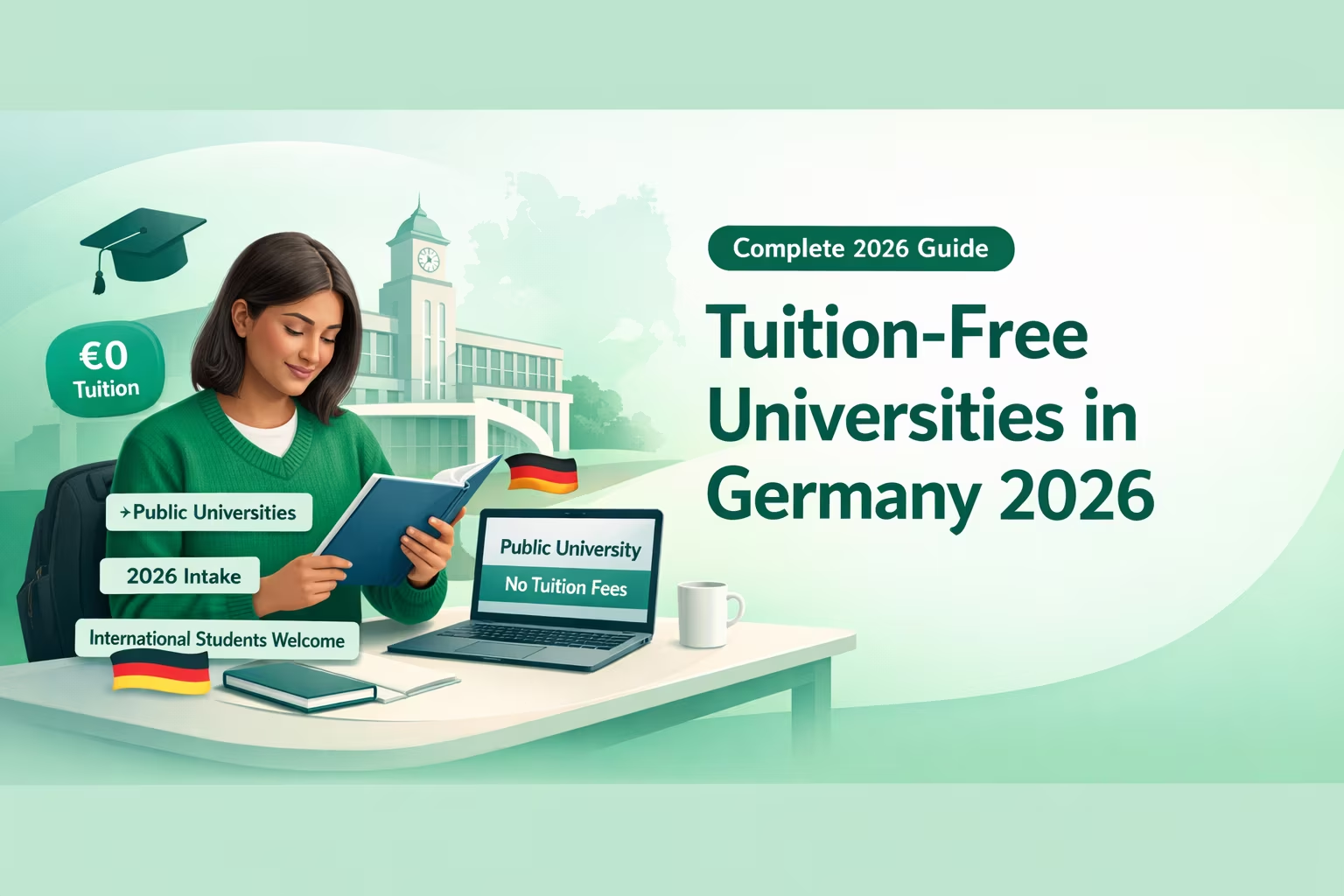
The Ultimate Guide to Tuition-Free Universities in Germany 2026
Welcome to the definitive guide on studying in Europe's academic and economic powerhouse. If you are searching for Tuition-Free Universities in Germany 2026, you have arrived at the right place. As tuition fees in destinations like the USA, the UK, and Australia reach historic highs, Germany stands out as a beacon of world-class, affordable education. This guide will walk you through the entire landscape of higher education in Germany, from understanding how the tuition-free system works to choosing the best university, managing your living expenses, and successfully securing your student visa.
For decades, Germany has championed the philosophy that higher education should be accessible to everyone, regardless of their financial background or nationality. Whether you are an undergraduate student looking for an exceptional engineering program or a postgraduate applicant seeking advanced research opportunities in the sciences, studying in Germany without tuition fees is a reality that hundreds of thousands of international students benefit from every year. When you compare the financial commitment to top-tier universities in North America, where degrees can easily exceed $100,000, the savings in Germany are absolutely monumental.
2026 International Student Eligibility Snapshot
- ✓Who is Eligible? Both EU and non-EU international students qualify for tuition-free education at public universities.
- ✓What is Covered? 100% of standard academic tuition fees for bachelor's and consecutive master's degrees.
- ✓What do you pay? Only a nominal Semesterbeitrag (semester contribution) ranging from €150 to €350, which often includes a public transport ticket.
Tuition-free universities in Germany for international students (2026)
Yes, international students can study at tuition-free public universities in Germany in 2026. At public universities in almost every German state, both domestic and international students pay no tuition fees for undergraduate and most master's programmes, and instead pay only a small semester contribution. The main costs to plan for are living expenses and the blocked-account requirement for your student visa, not tuition. The sections below list the top tuition-free public universities, the English-taught programmes open to international students, the exact 2026 costs, and the visa steps.
Why Germany Offers Tuition-Free Education in 2026
It naturally sounds too good to be true: highly ranked, globally respected institutions offering top-tier degrees for essentially zero cost. However, the German higher education system operates on a unique public funding model. Education in Germany is viewed not as a commercial product, but as a fundamental public good and a vital investment in the nation's future economic and intellectual infrastructure.
The German federal and state governments heavily subsidize public universities. Instead of shifting the financial burden onto students, the state utilizes tax revenues to fund academic institutions. This strategy ensures that the country continues to attract the brightest minds globally to its workforce, successfully combating domestic skilled labor shortages, particularly in STEM (Science, Technology, Engineering, and Mathematics) fields.
Understanding the Semester Contribution (Semesterbeitrag)
"Free" does not mean you will never open your wallet at the university registrar. Every student is required to pay a Semester Contribution. This is not a tuition fee; it is an administrative charge that directly benefits you. Usually costing between €150 and €350 per semester, it covers:
- Student Union Fees (Studentenwerk): Funds campus cafeterias (Mensa), dormitories, and athletic facilities.
- Semesterticket: A massively discounted public transportation pass allowing unlimited travel in your city and often the surrounding region.
- Administrative Costs: Registration and basic student services.
Crucial Exceptions: Where You MIGHT Pay Fees
While the vast majority of German public universities are tuition-free, transparency is key. Here are the exceptions to be aware of in 2026:
- The State of Baden-Württemberg: Since 2017, this specific federal state (home to Heidelberg University and University of Stuttgart) charges non-EU international students a tuition fee of €1,500 per semester.
- The State of Bavaria (TUM Exceptions): The Technical University of Munich (TUM) recently introduced fees for non-EU students depending on the program (ranging from €2,000 to €6,000 per semester). Other Bavarian universities are currently evaluating similar policies.
- Non-Consecutive Master's Degrees: If your master's degree is in a completely different field than your bachelor's (or if you are pursuing an MBA), universities may charge tuition fees.
- Private Universities: Germany has a growing sector of private universities. These do not receive state funding and charge standard international tuition fees (often €10,000 to €20,000+ per year).
Top 20 Tuition-Free Universities in Germany 2026
With over 300 public universities scattered across the country, narrowing down your choices can be overwhelming. Below is a curated list of the absolute best public universities in Germany offering free education for international students. These institutions rank highly on global indices like QS and THE, and they offer a broad array of English-taught programs.
1. LMU Munich
Top 100 Global
Location: Munich, Bavaria
Consistently ranked as Germany’s #1 or #2 university, Ludwig Maximilian University offers prestige and research excellence. Note: LMU remains tuition-free despite TUM’s recent policy changes.
2. RWTH Aachen University
TU9 Member
Location: Aachen, North Rhine-Westphalia
The largest technical university in Germany. It maintains incredibly strong ties with European industry, making it a dream destination for engineering and tech students.
3. Humboldt University of Berlin
Elite Research
Location: Berlin
Situated in the vibrant capital, Humboldt is world-renowned for humanities and arts. Its alumni list features 29 Nobel laureates, including Albert Einstein.
4. Free University of Berlin
Excellence Univ.
Location: Berlin
Known for its highly international student body and research in political science and humanities. It offers a very supportive environment for expats.
5. TU Berlin
TU9 Member
Location: Berlin
A leader in technical and engineering disciplines. Located in Europe’s startup hub, offering students incredible networking and internship opportunities.
6. Goethe University Frankfurt
Financial Hub
Location: Frankfurt, Hesse
Located in the financial capital of continental Europe, providing unmatched pathways into banking, finance, and corporate law.
7. University of Cologne
Top Research
Location: Cologne, North Rhine-Westphalia
One of the oldest and largest universities in Germany, with a strong focus on economics, social sciences, and humanities.
8. University of Münster
Excellent Teaching
Location: Münster, North Rhine-Westphalia
A comprehensive university known for its excellence in law, business, and life sciences, set in one of Germany’s most bike-friendly cities.
9. University of Göttingen
Nobel Legacy
Location: Göttingen, Lower Saxony
Famous for its strong research tradition in natural sciences and mathematics, with over 45 Nobel Prize winners associated.
10. TU Dresden
TU9 Member
Location: Dresden, Saxony
A TU9 university with outstanding engineering and microelectronics programs, embedded in a beautiful historic city.
11. University of Bonn
Excellence University
Location: Bonn, North Rhine-Westphalia
An elite research university with strong mathematics, economics, and astrophysics departments, recently awarded Excellence status.
12. University of Würzburg
Top Research
Location: Würzburg, Bavaria
A historic university with cutting-edge research in biomedicine and quantum physics, offering a vibrant student life.
13. University of Hamburg
Excellent Research
Location: Hamburg
Northern Germany’s largest research university, with strengths in climate research, law, and humanities.
14. University of Leipzig
Historic Excellence
Location: Leipzig, Saxony
One of Germany’s oldest universities, with a strong reputation in medicine, biosciences, and the humanities.
15. Ruhr University Bochum
Interdisciplinary
Location: Bochum, North Rhine-Westphalia
A modern campus university with interdisciplinary research in IT security, neuroscience, and engineering.
16. University of Stuttgart
Baden-Württemberg Fee
Location: Stuttgart, Baden-Württemberg
Note: Non-EU students pay €1,500/semester due to state policy. Excellent engineering, architecture, and IT programs.
17. Karlsruhe Institute of Technology (KIT)
TU9 & Excellence
Location: Karlsruhe, Baden-Württemberg
Germany’s only “University of Excellence” combining a university and a national research center. Strong in CS, engineering, and natural sciences.
18. University of Freiburg
Excellence
Location: Freiburg, Baden-Württemberg
A prestigious research university strong in humanities, sustainability, and life sciences. Non-EU students pay fees in Baden-Württemberg.
19. University of Tübingen
Elite University
Location: Tübingen, Baden-Württemberg
Renowned for theology, humanities, and molecular biology. A classic university town with a vibrant student atmosphere.
20. University of Konstanz
Excellence
Location: Konstanz, Baden-Württemberg
A “University of Excellence” with strong social sciences, politics, and public administration. Beautiful location on Lake Constance.
Other highly notable tuition-free institutions include: University of Cologne, University of Münster, University of Göttingen, TU Dresden, University of Bonn, University of Würzburg, University of Hamburg, University of Leipzig, and Ruhr University Bochum.
Cost of Studying in Germany 2026: The Real Budget
Even with tuition fees removed from the equation, you must accurately budget for your cost of living. For the 2026 academic year, the German government mandates that international students demonstrate financial self-sufficiency. This is managed through a Blocked Account (Sperrkonto).
Currently, the required blocked account amount is set to €11,904 per year, which translates to a strict withdrawal limit of €992 per month. This number is carefully calculated by the government to represent the minimum realistic cost of living for a student.
Estimated Monthly Budget Breakdown
| Expense Category | Estimated Monthly Cost (€) | Tips to Save |
|---|---|---|
| Rent (WG or Dorm) | €350 – €550 | Apply early for Studentenwerk dorms |
| Food & Groceries | €200 – €250 | Shop at Aldi, Lidl, Netto; eat at Mensa |
| Health Insurance | €120 – €130 | Mandatory public insurance (TK, AOK) |
| Internet & Mobile | €30 – €40 | Use student discounts on phone plans |
| Leisure & Misc. | €80 – €150 | Use student ID for museum/event discounts |
| Total Estimated | €780 – €1,120 / month | Depends heavily on the city |
Note on City Variations: Cities like Munich, Frankfurt, and Stuttgart are notoriously expensive regarding rent. Conversely, eastern cities like Leipzig, Dresden, and Halle offer incredibly low living costs, often allowing students to live comfortably on just €800 per month.
Comparing costs across destinations? Read Planning Your Master's in 2026: USA vs Australia vs Europe vs Canada for the full budget comparison.
Admission Requirements for International Students
Securing a spot at a tuition-free public university is highly competitive. German universities utilize a purely merit-based system. Your academic GPA and subject prerequisites are the most critical factors. Unlike the holistic admissions processes in the US, German universities rely strictly on academic metrics.
1. Academic Qualifications (HZB)
You must possess a recognized university entrance qualification, known in Germany as a Hochschulzugangsberechtigung (HZB). For master's applicants, your bachelor's degree must be equivalent to a German bachelor's degree, and heavily related to the master's program you are applying for.
2. Language Proficiency
- For English-Taught Programs: You must submit IELTS (usually a minimum of 6.5) or TOEFL iBT (usually 90+).
- For German-Taught Programs: You need advanced German proficiency, proven by tests like TestDaF (level 4 in all sections), DSH-2, or Goethe-Zertifikat C1/C2.
3. The APS Certificate (Mandatory for Specific Countries)
If you are applying from India, China, or Vietnam, the APS (Akademische Prüfstelle) certificate is now a mandatory prerequisite for both the university application and the visa. It serves to verify the authenticity of your domestic educational documents.
4. Application Portals
Around 50% of German universities require you to apply through a centralized portal called Uni-Assist, which evaluates international certificates for a fee (approx. €75 for the first application, €30 for subsequent ones). The other 50% allow direct applications through their own university web portals.
Germany Student Visa Process 2026
Once you hold an unconditional offer letter from a German public university, your next immediate step is navigating the bureaucratic but straightforward student visa process.
Open a Blocked Account
Deposit €11,904 into a certified German blocked account (e.g., Expatrio, Coracle, Fintiba). You will receive a blocking confirmation document.
Secure Health Insurance
Sign up for statutory student health insurance (approx. €120/month). The insurance provider will generate a digital confirmation (M10 status) required by the university and consulate.
Compile Documents
Gather your passport, university admission letter, blocked account confirmation, health insurance certificate, APS certificate (if applicable), academic transcripts, and motivational letter.
Consulate Interview
Book an appointment at your local VFS Global center or German Embassy. The visa processing time generally ranges from 4 to 8 weeks.
Your IELTS score is part of this checklist — see the minimum IELTS score universities ask for in 2026 before you finalise your university shortlist.
Scholarships & Financial Aid
Even with no tuition fees, living expenses can be daunting. Fortunately, Germany provides substantial financial support for international scholars.
DAAD Scholarships
The German Academic Exchange Service (DAAD) is the largest funding organization in the world for international exchange. DAAD scholarships primarily target master's and doctoral students, offering monthly stipends (typically €934 for master's and €1,200 for PhDs), travel allowances, and health insurance coverage.
Deutschlandstipendium
The "Germany Scholarship" provides financial and non-material support to high-achieving students from all over the world. It awards €300 per month (€150 from the government, €150 from private sponsors) and is purely merit-based, completely independent of your personal income or nationality.
Part-Time Work Rights
If you don't secure a scholarship, part-time work is standard for students in Germany. International students on a visa are legally permitted to work 140 full days or 280 half-days per calendar year. With the German minimum wage currently set at over €12.41 per hour, working part-time (e.g., as a HiWi - student assistant, or in retail) can easily cover a large portion of your monthly living expenses.
Advantages & Challenges of Studying in Germany
It is crucial to approach your study abroad journey with realistic expectations. Germany is phenomenal, but it presents unique challenges.
🟢 The Advantages
- Zero Tuition Debt: Graduate without crippling student loans.
- Post-Study Work Visa: Automatically receive an 18-month visa to find a job after graduation.
- Schengen Visa Access: Travel freely across 27 European countries.
- World-Class Research: Access to elite labs and professors.
- Safe & Stable: High quality of life, excellent public transport, and very low crime rates.
🔴 The Challenges
- Language Barrier: Bureaucracy and everyday life operate in German; learning it is essential for integration.
- Extreme Bureaucracy: Extensive paperwork for visas, banking, and university enrollment.
- Rigorous Academics: Very high failure rates in exams; professors expect extreme independence.
- Housing Crisis: Finding a room in cities like Munich or Berlin can take months.
Step-by-Step Plan to Study in Germany (2026 Intake)
If you aim to start your studies in the Winter Semester of 2026 (starts October), you need a strict timeline. Here is a realistic roadmap.
August – December 2025: Research & Prep
Shortlist 5-7 tuition-free universities. Verify exact admission requirements on DAAD. Take IELTS/TOEFL. Initiate APS certification process (if applicable, as it takes months).
January – March 2026: Document Assembly
Gather transcripts, translate documents, write motivation letters, and procure academic letters of recommendation.
April – May 2026: Application Phase
Submit applications via Uni-Assist or direct university portals. Pay application fees. Ensure all documents arrive before the deadlines (usually May 31 or July 15).
July – August 2026: Admission & Visa
Receive admission letters. Immediately open your blocked account, transfer €11,904, buy health insurance, and apply for your German student visa.
September 2026: Relocation
Fly to Germany, move into your accommodation, register at the local citizen's office (Bürgeramt), enroll at the university, and attend orientation week.
2026 Update: Winter Semester 2026-27 Application Window & Fee Changes
The German university application calendar runs on two intakes — Winter Semester (applications typically close 15 July, lectures begin in October) and Summer Semester (applications close 15 January, lectures begin in April). Most international students target the Winter Semester because it carries more programme options and easier scholarship eligibility. Three things to keep on your radar for the Winter Semester 2026-27 cycle:
- Semester contribution increases. The semester contribution (the small administrative + public-transport fee that replaces tuition at public German universities) has crept up at most institutions for 2026-27, typically landing between €280 and €380 per semester. TU Munich and the University of Heidelberg are at the lower end; LMU Munich, RWTH Aachen and most Berlin universities are at the upper end. Confirm the exact figure on your destination university's International Office page before budgeting.
- Digital application via uni-assist is now the default. The shared application portal uni-assist handles most international applications, with a flat handling fee per application (€75 first programme, €30 each additional). A growing number of universities — including Heidelberg and the Berlin Hochschulen — have shifted to fully digital document submission, removing the previous requirement to post certified paper transcripts. Allow eight weeks for uni-assist to verify your documents before the 15 July deadline.
- English-taught Master's programmes continue to expand. Roughly 1,800 fully English-taught Master's programmes are now listed in the DAAD's 2026 catalogue — up from about 1,300 in 2022. Engineering, computer science, and international management dominate. Most still publish a minimum IELTS Academic of 6.5 with no element below 6.0; medicine and clinical psychology remain German-language programmes for the foreseeable future.
June 2026 check: if you miss the 15 July 2026 deadline for Winter Semester 2026-27, the next entry point is the Summer Semester 2027 intake — applications close 15 January 2027, with lectures starting in April. Fewer programmes admit in summer (many master's courses are winter-entry only), so check your target programme accepts summer starters before planning around it.
The Blocked Account requirement for the international student visa was raised on 1 September 2024 to €11,904 per year (€992 per month) and remains at that level for 2026 intakes — budget accordingly when opening your Deutsche Bank, Expatrio, or Fintiba blocked account. The Federal Government has signalled that this figure will be reviewed annually against cost-of-living inflation, so check the exact figure with the German consulate handling your visa within four weeks of your appointment.
IELTS Requirements at German Universities (June 2026 Check)
Tuition-free does not mean requirement-free. For English-taught programmes, German public universities set their language bar per programme, and the pattern across the sector is consistent:
| Programme type | Typical IELTS asked | Notes |
|---|---|---|
| English-taught Master's (standard) | 6.5 overall, no band below 6.0 | The most common published requirement across TU9 and Excellence universities |
| Competitive programmes (e.g. management, data science) | 7.0 overall, often 6.5 per band | TUM Management and similar high-demand courses sit here |
| German-taught programmes | No IELTS | TestDaF 4 / DSH-2 / Goethe C1-C2 replace it entirely |
Always confirm the exact band in the programme's own admission page — requirements are set per degree, not per university. For a verified example of how one top German university publishes its bands, see the Technical University of Munich IELTS requirement, or compare minimum IELTS scores at 49 universities worldwide. If you are not yet at 6.5, a scored free IELTS mock test tells you exactly how far away you are before you spend anything on the real exam.
Conclusion
Enrolling in Tuition-Free Universities in Germany 2026 is undoubtedly one of the smartest academic and financial decisions an international student can make. By eliminating the crushing burden of tuition fees, Germany allows you to focus purely on intellectual growth, cultural immersion, and career building in Europe's strongest economy.
While the process requires meticulous planning—from mastering the Uni-Assist portal to funding a blocked account and securing a student visa—the reward is a premium, globally recognized degree that costs a fraction of the price elsewhere. Start your research early, learn some basic German, and prepare to embark on a life-changing educational journey!
Comparing destinations? Read these next
- Planning a Master's in 2026: USA vs Canada vs Australia vs Europe — full timeline, costs and IELTS requirements by country.
- Top Master's Universities in the USA 2026 — if you're weighing the US against tuition-free Germany.
- Top Master's Universities in Canada 2026 — another popular low-cost, PR-friendly destination.