
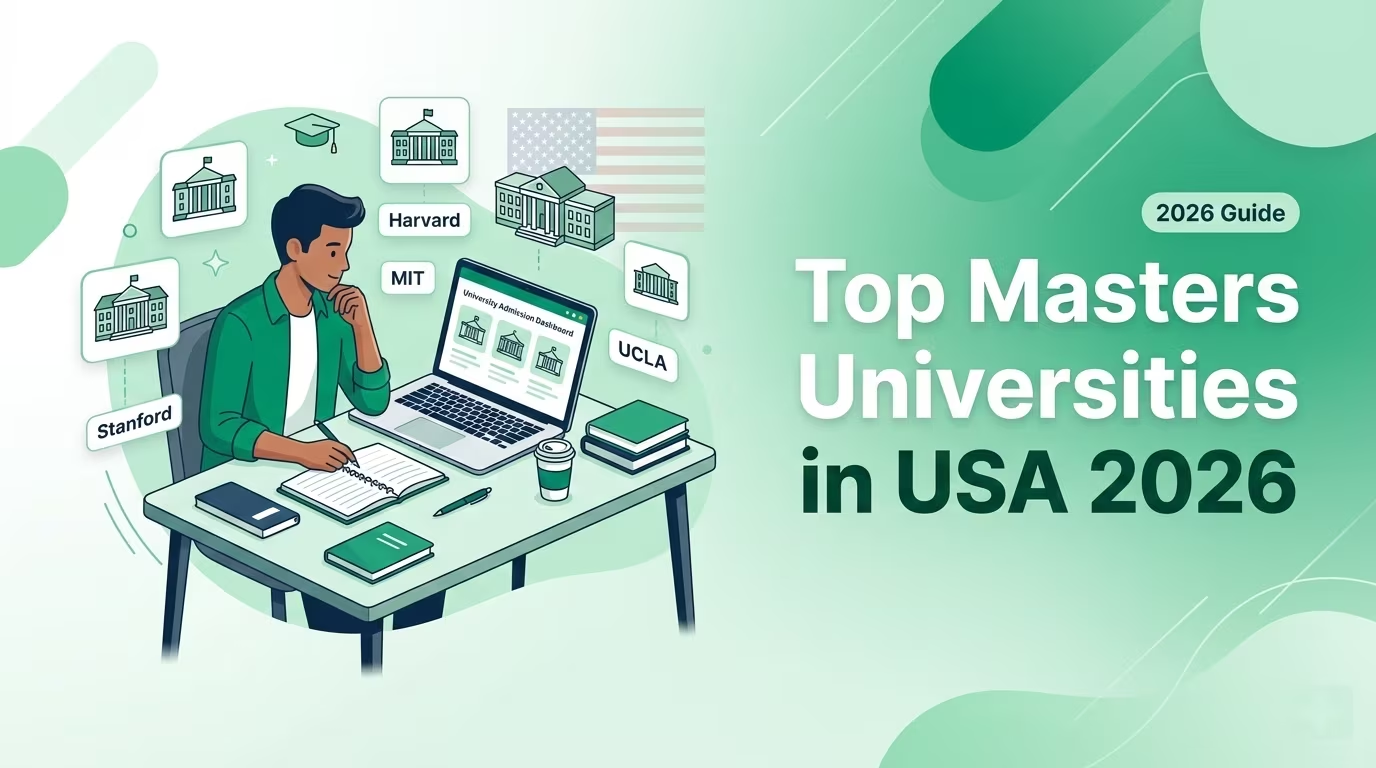
The Ultimate Guide to Top Master’s Universities in USA 2026 – Rankings, Fees & Admission
Welcome to the definitive guide on pursuing a Master’s degree in the United States. If you are searching for the best universities in USA for Masters 2026, you have arrived at the right place. The US remains the world’s top destination for graduate education, offering unparalleled research opportunities, diverse programs, and strong career outcomes. This guide will walk you through the entire landscape of American higher education—from understanding the application process and tuition fees to choosing the right university and securing your student visa.
For decades, the United States has attracted the brightest minds from around the globe. With over 4,000 accredited institutions, you can find programs in every field imaginable. Whether you aim to study Engineering at MIT, Business at Stanford, or Public Health at Johns Hopkins, the US provides a rich academic environment, cutting-edge facilities, and a multicultural experience that is hard to match elsewhere.
2026 International Student Snapshot
- ✓Who can apply? Students from all countries with a recognized bachelor’s degree.
- ✓Program duration: 1–2 years (30–60 credits).
- ✓Work opportunities: Up to 3 years of OPT (STEM) after graduation.
Why Study in the USA? Unmatched Opportunities
American universities consistently dominate global rankings, and for good reason. They offer flexibility in curriculum, access to world-renowned faculty, and state-of-the-art laboratories. But beyond academics, the US provides a unique cultural experience and a gateway to international career opportunities.
Academic Excellence & Research
US institutions invest heavily in research. As a graduate student, you may work alongside Nobel laureates, contribute to groundbreaking discoveries, and publish in top journals. Many programs offer teaching or research assistantships that cover tuition and provide a stipend.
Post-Graduation Work Options (OPT)
International students on an F-1 visa can apply for Optional Practical Training (OPT) after completing their degree. Standard OPT lasts 12 months, but graduates with a STEM-designated degree can extend for an additional 24 months. This allows you to gain valuable work experience in the US and potentially transition to an H-1B visa.
Diverse & Inclusive Environment
With students from over 200 countries, US campuses are melting pots of cultures. You’ll build a global network that lasts a lifetime. Universities also provide extensive support services for international students, including orientation, English language help, and career counseling.
Top 20 Universities in USA for Master’s Degrees 2026
The United States is home to hundreds of excellent graduate schools. Below is a curated list of 20 top-tier universities that offer outstanding Master’s programs for international students. These institutions are highly ranked globally and provide a wide array of English-taught courses, strong industry connections, and robust career support.
1. Massachusetts Institute of Technology (MIT)
Ranked #1 in USA
Location: Cambridge, Massachusetts
MIT is globally recognized for its leadership in Science, Technology, Engineering, and Mathematics. It offers exceptional graduate programs with unparalleled research opportunities, innovation ecosystems, and industry connections in tech and engineering sectors.
2. Stanford University
Ranked #2 in USA
Location: Stanford, California
Located in the heart of Silicon Valley, Stanford offers exceptional Masters programs in Computer Science, Business, Engineering, and Law. Proximity to tech giants provides unparalleled internship and networking opportunities.
3. Harvard University
Ranked #3 in USA
Location: Cambridge, Massachusetts
As America's oldest institution, Harvard offers prestigious graduate programs across all disciplines. Its Business (HBS), Law (HLS), Medicine, and Government schools are world-renowned for academic excellence and influential alumni networks.
4. California Institute of Technology (Caltech)
Top 5 in USA
Location: Pasadena, California
Caltech is renowned for its strength in Science and Engineering. With a small student body and exceptional faculty-to-student ratio, it provides intensive research opportunities and state-of-the-art facilities for STEM graduate students.
5. University of Chicago
Top 10 in USA
Location: Chicago, Illinois
Renowned for rigorous academic programs and strength in Economics, Business (Booth School), Law, and Social Sciences. The quarter system provides flexible scheduling for graduate students.
6. University of Pennsylvania
Ivy League University
Location: Philadelphia, Pennsylvania
UPenn offers exceptional graduate programs through its Wharton School of Business, School of Engineering, and Perelman School of Medicine. Interdisciplinary approach and strong industry connections provide excellent career opportunities.
7. Princeton University
Ivy League University
Location: Princeton, New Jersey
Princeton offers highly selective graduate programs with generous funding packages. It excels in Humanities, Social Sciences, Natural Sciences, and Engineering, with strong emphasis on original research.
8. Yale University
Ivy League University
Location: New Haven, Connecticut
Yale offers prestigious graduate programs through its Graduate School of Arts and Sciences and professional schools. Particularly strong in Law, Management, Medicine, and Environmental Studies.
9. Cornell University
Ivy League University
Location: Ithaca, New York
Cornell offers diverse graduate programs across its colleges. Strong in Engineering, Hotel Administration, Agriculture, and Computer Science, with extensive research facilities and industry partnerships.
10. Columbia University
Ivy League University
Location: New York, New York
Located in NYC, Columbia offers exceptional graduate programs with access to unparalleled professional networks. Excels in Journalism, Business, International Affairs, and Engineering.
11. University of Michigan – Ann Arbor
Top Public University
Location: Ann Arbor, Michigan
A top public research university offering excellent graduate programs across disciplines. Strong in Engineering, Business (Ross School), Public Policy, and Medicine, with extensive research funding.
12. Johns Hopkins University
Top for Medicine & Public Health
Location: Baltimore, Maryland
World-renowned for its Medical School and Bloomberg School of Public Health. Also offers excellent graduate programs in Engineering, International Studies, and Biotechnology.
13. Northwestern University
Top for Journalism & Media
Location: Evanston, Illinois
Offers exceptional graduate programs through its Kellogg School of Management, Medill School of Journalism, and McCormick School of Engineering. Strong professional networks provide excellent career opportunities.
14. University of California, Berkeley (UCB)
Top Public University
Location: Berkeley, California
World-class graduate programs in Engineering, Computer Science, Business (Haas School), and Environmental Science. Location provides access to Silicon Valley’s innovation ecosystem.
15. University of California, Los Angeles (UCLA)
Top Public University
Location: Los Angeles, California
Diverse graduate programs with strengths in Film & Television, Business (Anderson School), Medicine, and Engineering. Access to entertainment, tech, and biomedical industries.
16. Duke University
Top Private University
Location: Durham, North Carolina
Prestigious graduate programs through its Fuqua School of Business, School of Medicine, and School of Law. Research triangle location provides strong industry connections in tech and healthcare.
17. University of Texas at Austin
Top Public University
Location: Austin, Texas
Excellent graduate programs in Engineering, Business (McCombs School), and Computer Science. Located in Texas’ capital, with strong connections to tech, energy, and government sectors.
18. New York University (NYU)
Top Urban University
Location: New York, New York
Exceptional graduate programs with direct access to professional networks in finance, media, arts, and technology. Stern School of Business and Tisch School of the Arts are particularly renowned.
19. Carnegie Mellon University
Top for Computer Science
Location: Pittsburgh, Pennsylvania
Globally recognized for programs in Computer Science, Engineering, and Robotics. Strong industry partnerships and cutting-edge research facilities provide excellent opportunities for graduate students.
20. University of Washington
Top Public University
Location: Seattle, Washington
Excellent graduate programs in Computer Science, Engineering, and Medicine. Proximity to Amazon, Microsoft, and other tech giants provides exceptional internship and employment opportunities.
Note: This list includes both private and public universities. Tuition and fees vary significantly; always check the official program website for the most current information.
Cost of Studying in the USA 2026: What to Budget
Studying in the US requires careful financial planning. Tuition fees and living expenses vary widely depending on the university, program, and location. International students must demonstrate sufficient funds to cover at least the first year of study when applying for an F-1 visa.
Estimated Annual Budget Breakdown
| Expense Category | Estimated Annual Cost (USD) | Notes |
|---|---|---|
| Tuition Fees | $20,000 – $70,000 | Varies by program (public vs private) |
| Accommodation | $8,000 – $18,000 | On-campus or off-campus |
| Food & Groceries | $4,000 – $7,000 | Meal plans or cooking at home |
| Health Insurance | $1,500 – $3,000 | Mandatory for all students |
| Transportation | $1,000 – $2,500 | Local transit, occasional travel |
| Books & Supplies | $1,000 – $2,500 | Digital materials can reduce cost |
| Personal Expenses | $3,000 – $5,000 | Clothing, entertainment, etc. |
| Total Estimated | $38,500 – $108,000 | Per academic year (9–12 months) |
Financial proof requirement: For the F-1 visa, you must show liquid funds equal to the first year’s total cost (tuition + living expenses). This is typically documented through bank statements, sponsorship letters, or scholarship awards.
Admission Requirements for International Students
Admission to US graduate schools is competitive and holistic. While each university sets its own criteria, the following are common requirements for Master’s programs:
1. Academic Qualifications
A four-year bachelor’s degree (or equivalent) from a recognized institution. Most universities require a minimum GPA of 3.0 on a 4.0 scale (or equivalent). Some programs may require specific coursework.
2. Standardized Tests
- GRE/GMAT: Many graduate programs require the Graduate Record Examination (GRE) or Graduate Management Admission Test (GMAT). However, an increasing number of programs are waiving this requirement for 2026 – check individual websites.
- English Proficiency: Non-native English speakers must submit TOEFL iBT (typically 90–100) or IELTS (typically 6.5–7.5). Some universities accept Duolingo English Test.
3. Supporting Documents
- Letters of Recommendation: Usually 2–3 academic or professional references.
- Statement of Purpose: A personal essay explaining your goals, why you chose the program, and what you bring to the university.
- CV/Resume: Highlighting academic achievements, work experience, internships, and publications.
- Transcripts: Official academic records from all post-secondary institutions attended.
4. Application Portals
Most US universities use centralized application systems like the Common Application (for some graduate programs) or their own online portals. Many also use ApplyWeb or CollegeNet. Pay close attention to deadlines, which typically fall between December and February for Fall intake.
US Student Visa Process (F-1) 2026
Once admitted, you will receive an I-20 form from your university. This is required to apply for the F-1 student visa at a US embassy or consulate in your home country. Follow these steps:
Pay the SEVIS Fee
After receiving your I-20, pay the I-901 SEVIS fee (currently $350) online and print the receipt.
Complete the DS-160 Form
Fill out the online nonimmigrant visa application (DS-160) and upload a photo that meets US visa requirements.
Pay the Visa Fee & Schedule Interview
Pay the visa application fee (approx. $160) and schedule an interview at the nearest US embassy or consulate. Wait times vary; book early.
Gather Documents for Interview
Bring your I-20, DS-160 confirmation, SEVIS fee receipt, passport, financial documents, admission letter, test scores, and academic transcripts.
Attend the Interview
Answer questions about your study plans, ties to home country, and financial support. If approved, your passport will be returned with the visa.
Internal Link Suggestion: Complete F-1 Visa Checklist for 2026.
Scholarships & Financial Aid
Although US education can be expensive, numerous funding opportunities exist for international students. These include merit-based scholarships, need-based aid, and assistantships.
Fulbright Foreign Student Program
The Fulbright Program is the flagship international educational exchange program sponsored by the US government. It provides full funding (tuition, airfare, living stipend, health insurance) for graduate students, young professionals, and artists from abroad to study in the US.
University-Specific Scholarships & Assistantships
Many universities offer merit-based scholarships, teaching assistantships (TA), and research assistantships (RA) to outstanding international students. These often include a full or partial tuition waiver plus a monthly stipend. Check each program’s website for opportunities.
Private Foundations & Organizations
Organizations like the Rotary Foundation, AAUW International Fellowships, and Aga Khan Foundation provide scholarships for specific countries or fields of study. Additionally, professional associations in your field may offer small grants.
On-Campus Employment
F-1 students can work on campus up to 20 hours per week during the academic year and full-time during breaks. Jobs include library assistants, research aides, or positions in the student union. This can help cover incidental expenses.
Advantages & Challenges of Studying in the USA
Studying in the US is a life-changing experience, but it’s important to weigh both the benefits and the hurdles.
🟢 The Advantages
- World-Class Education: Access to top-ranked universities and cutting-edge research.
- Flexible Curriculum: Choose courses across disciplines to tailor your degree.
- Career Opportunities: OPT allows 1–3 years of work experience after graduation.
- Global Network: Build lifelong connections with peers from around the world.
- Cultural Diversity: Experience a multicultural environment on campus and beyond.
🔴 The Challenges
- High Cost: Tuition and living expenses can exceed $100,000 per year.
- Complex Visa Process: Strict documentation and interview requirements.
- Distance from Home: Being far from family can be emotionally challenging.
- Healthcare System: Must purchase health insurance; medical costs are high.
- Cultural Adjustment: Adapting to new social norms and academic expectations.
Step-by-Step Plan to Study in the USA (2026 Intake)
To start your Master’s in Fall 2026, follow this realistic timeline:
January – June 2025: Research & Prep
Shortlist 8–10 universities. Check admission requirements, deadlines, and funding options. Register for GRE/GMAT and English tests.
July – September 2025: Take Tests & Prepare Documents
Take GRE/GMAT and TOEFL/IELTS. Request transcripts, draft statement of purpose, and ask for recommendation letters.
October – December 2025: Apply
Submit applications through university portals. Pay application fees. Ensure all materials (including test scores) arrive before deadlines.
January – March 2026: Receive Decisions & Funding
Admission decisions arrive. Compare offers and any scholarships/assistantships. Accept an offer and pay any deposit.
April – July 2026: I-20 & Visa Process
Receive I-20 from your university. Pay SEVIS fee, complete DS-160, schedule visa interview, and prepare financial documents.
August 2026: Arrival & Orientation
Fly to the US, attend international student orientation, register for classes, and explore your new campus.
Conclusion
Pursuing a Master’s degree in the United States is an investment in your future. The academic rigor, cultural diversity, and career prospects are unmatched. While the cost and application process can be daunting, careful planning and early preparation will put you on the path to success.
Whether you dream of conducting research at MIT, launching a startup from Stanford, or influencing policy at Harvard, the US offers a program for every ambition. Start your journey today—research universities, connect with alumni, and prepare your strongest application. Your American dream awaits!